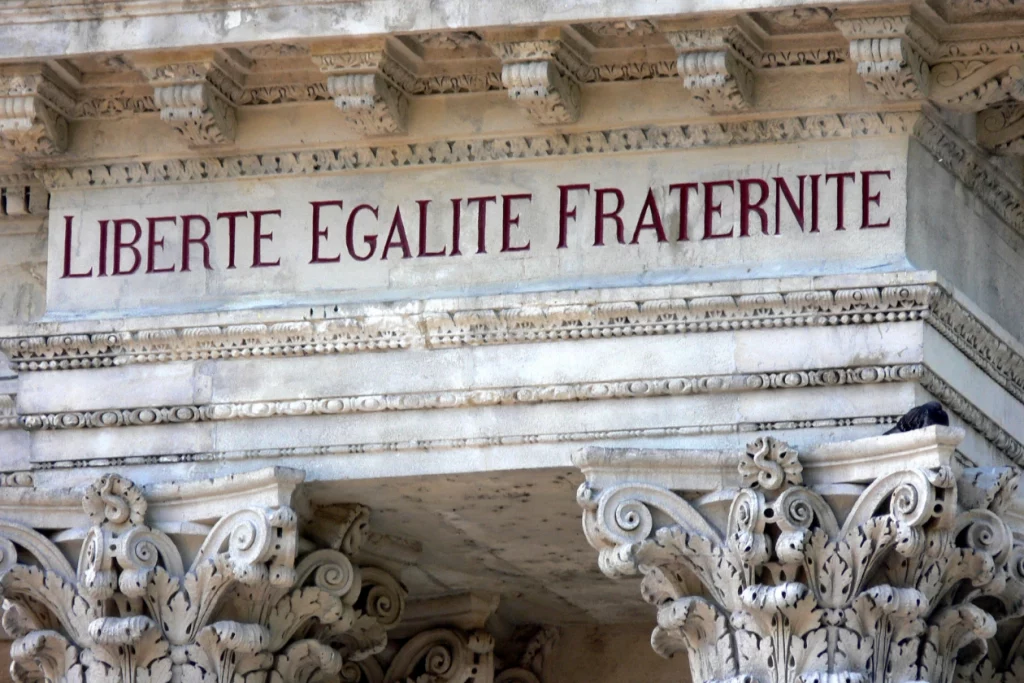
Liberty, equality and fraternity were Dr Ambedkar’s central socio-political ideals. They are ubiquitous in his writings and speeches, and he wrote them into the constitution of India, where, along with Justice, they are named in the Preamble as the foundational principles of the Indian state. But he also believed that alongside them, underlying them, or in addition to them (depending how one looks at it) society needed religion. As we saw in Part 1, his main concern seems to have been that society should have a moral underpinning, but he said that this should be ‘sacred and universal’,1 for which he believed religion was necessary. Finding no universal morality in Hinduism he decided it was necessary to convert to another religion; and after a long process he settled upon Buddhism.
Thus, as Ambedkar’s thought developed, and as he approached the great mass conversion, he understood liberty, equality and fraternity from an increasingly Dharmic point of view. Eventually he went so far as to say that he learned them not from the French Revolution but ‘from my master the Buddha’. Given that the Buddha never spoke in those terms this clearly can’t be taken too literally. What I think Ambedkar meant by it will be the substance of this and the following article. I will base my argument on three sources in which he talks of liberty, equality and fraternity in a variety of ways. In Part 3 I will bring these different perspectives together and make some extrapolations. This, I hope, will give us the clarifying and unifying perspective I have been seeking, which is so needed in our troubled and confusing world.
India and the Pre-requisites of Communism
The first source I want to draw from is a paper that was published posthumously as India and the Prerequisites of Communism.2 In it, he talks about the two conditions for a free social order. The first is that
…the individual is an end in himself. And that the aim and object of society is the growth of the individual and the development of his personality.3 Society is not above the individual. And if the individual has to subordinate himself to society, it is because such subordination is for his betterment, and only to the extent necessary.
This is something I believe needs to be borne in mind for anyone involving themselves in social justice causes. If one is to advocate on behalf of a body of people who are collectively disadvantaged, obviously one needs to relate to them to some extent on the basis of their social category. But Ambedkar was clear that that should be subordinate to seeing them primarily as individuals. Indeed, I suggest that this could be seen as one of the criteria for judging whether social justice advocacy is justified and is being done on the right basis. Much of what comes under the rubric of ‘social justice’ these days fails this test. For decades, social justice causes, especially those associated with racial and LGBT justice, have increasingly been corrupted by ideological presuppositions that foreground group-identity over individuality. The effect on the moral integrity and effectiveness of those movements has been disastrous.4
But there is another point which is perhaps a bit deeper. If we are to say, with Ambedkar, that the growth of the individual is the aim and object of society, this must be seen in relation to a specific conception of what form such growth might take. And Buddhism, of course, promises an unlimited potential for the growth of the individual, for the development of his or her personality, and a transcendent ideal towards which to develop. In a talk called ‘What Path to Salvation?’ Ambedkar made explicit that he saw religion also in terms of the primacy of the individual.
A religion which does not recognize the individual is not acceptable to me personally. Although society is necessary for the individual, social welfare cannot be the ultimate goal of religion. To me, individual welfare and progress is the real aim of religion.
Thus, already we see a convergence of Ambedkar’s socio-political ideals and the spiritual ideals that he eventually led his people to.
The second condition of a free social order, as identified in India and the Prerequisites of Communism, is that ‘the terms of associated life between members of society must be regarded by consideration founded on liberty, equality and fraternity’. What is of particular interest is that he then draws out the connection between the two conditions: ‘…once the sacredness of human personality is admitted, the necessity of liberty, equality and fraternity must also be admitted as the proper climate for the development of personality.’
This gives us a way of understanding the real significance of liberty, equality and fraternity, namely that they provide the proper social climate for the development of the individual. It follows that these ideals themselves need to be seen in the light of the potential of the individual, and, to extrapolate further, that their highest manifestation is in relation to a transcendental ideal. This requires an extension of the meaning of these terms, far beyond the sphere of politics. I will examine the possibility of such an extension in Part 3.
Final speech to the Constituent Assembly
The second source I want to draw from is the speech that launched the Indian constitution, in the creation of which Ambedkar had for two years been the guiding hand. It was an important speech on a momentous occasion, launching a constitution that is now governing the lives of more than a billion people. It was also probably the zenith of Ambedkar’s political career. Widely acclaimed for his achievement, he could perhaps have bathed in the warm glow of success and the plaudits that it won him, but he didn’t. He was gracious in saluting those who had helped him. He was a little barbed in criticising those who had been obstructive (in particular the socialists, who thought that by trying to create a parliamentary democracy he had just got in the way of achieving a socialist dictatorship). But then he issued a warning. He said, in effect, don’t take this democracy for granted: democracy can be lost as well as made. And he identified three things needed to safeguard the future of democracy. While the third is the most germane to our discussion, the other two are also revealing and worthy of passing notice. He begins:
The first thing, in my judgment, we must do is to hold fast to constitutional methods of achieving our social and economic objectives. It means we must abandon the bloody methods of revolution. It means that we must abandon the method of civil disobedience, non-cooperation and satyagraha.5 When there was no way left for constitutional methods for achieving economic and social objectives, there was a great deal of justification for unconstitutional methods. But where constitutional methods are open, there can be no justification for these unconstitutional methods.
It is worth knowing that Ambedkar believed in the rule of law. He said elsewhere, ‘In parliamentary government, you have a duty and a right, the duty to obey the law and the right to criticize it’. This is something he practised as well as preached. Following the famous Chowder water tank protest, he chose to comply with the court’s decision forbidding further similar demonstrations. Rather than flout the law he fought a ten-year legal battle, which he eventually won.
Incidentally, this principle is one that Sangharakshita very much agreed with. In one of his relatively late writings he makes a distinction between principled and unprincipled vandalism. Principled vandalism, he says, is when people commit acts of vandalism for a higher purpose (or what they regard as such), about which he has this to say: ‘In my view, such principled — or rather unprincipled — vandalism should be treated as a crime and punished regardless of the merits of the cause for whose sake it was committed’.6 In this connection, it might be wondered how many of the significant numbers of his own followers who engaged in illegal activity in the name of climate change considered what he would have thought about such behaviour. I suspect he was turning in his burial mound — probably not for the last time.
Ambedkar’s second warning was against hero worship. ‘Bhakti’, he said, ‘or what may be called the path of devotional hero worship plays a part in India’s politics unequalled in magnitude by the part it plays in the politics of any other country in the world.’ He saw this as a very unhealthy tendency in the Indian psyche. It is a regrettable irony that a man who hated hero worship has himself become the object of a kind of blind devotion. Understandable as this is, it is not what he wanted. Indeed, after his conversion he said ‘I do not want any blind followers. I do not like sheep mentality’.
His third warning is more to the point:
The third thing we must do is not to be content with mere political democracy. We must make our political democracy a social democracy as well. Political democracy cannot last unless there lies at the base of it social democracy.
This is where we see John Dewey’s direct influence, since it was from him that Ambedkar took this distinction between political democracy and social democracy. The following from Annihilation of Caste is virtually a quote from Dewey:
Democracy is not merely a form of Government. It is primarily a mode of associated living, of conjoint communicated experience. It is essentially an attitude of respect and reverence towards fellow men.
This describes social democracy, though it must be understood that the term is being used in a specific sense: not as a form of government that blends a market economy with the redistribution of wealth by democratic means, but as a social spirit that is prior to any particular political system. Political democracy, on the other hand, refers to the system of government in which laws are made by elected representatives, involving political parties, campaigning, hustings, voting, the orderly transfer of power, and all the associated mechanisms. Ambedkar believed that the distinction was vital because without social democracy, political democracy is just window dressing, and can easily become merely another way for the powerful to consolidate their control.
The soul of Democracy [he said] is the doctrine of one man, one value. Unfortunately, Democracy has attempted to give effect to this doctrine only so far as the political structure is concerned by adopting the rule of one man, one vote which is supposed to translate into fact the doctrine of one man, one value.7
He then asks, ‘What does social democracy mean?’ His answer, ‘It means a way of life which recognizes liberty, equality, and fraternity as the principles of life’. That won’t be a great surprise by now. However, what he goes on to say is very significant.
These principles of liberty, equality, and fraternity are not to be treated as separate items in a trinity; they form a “union of trinity” in the sense that to divorce one from the other is to defeat the very purpose of democracy. Liberty cannot be divorced from equality, equality cannot be divorced from liberty, nor can liberty and equality be divorced from fraternity. Without equality, liberty would produce the supremacy of the few over the many. Equality without liberty would kill individual initiative. Without fraternity, liberty and equality could not become a natural course of things; it would require a constable to enforce them.
Here he is not only affirming the revolutionary triad as a whole; he is also recognising that the three principles exist in a state of tension and mutual moderation. Unless they are all present, balanced and harmonized, one can become over-emphasized at the expense of the others, resulting in a distortion. This gives us a way of looking at the nature of political ideology, and also a typology that allows us to classify any particular ideology in terms of its relation to the triad. In essence, an ideology is an over-emphasis on one or other of the three principles of the triad, and a failure to acknowledge that term’s relation with the others. Classical Marxism, for example, over-emphasises equality at the expense of liberty, while free-market economic liberalism does the reverse. Ideologies of national or racial supremacy rest on an exclusively narrow conception of fraternity. The historic clashes between capitalism, communism and fascism that rocked the world in the 20th century can be seen through this lens. Let us explore this idea.
While many of us no doubt regard liberalism as largely a good thing, problems arise when liberty, or the freedom of the individual, is taken as the ultimate political goal irrespective of consequences — of the welfare of the dispossessed, care for the environment, social cohesion, or any other legitimate moral concern. This is the ideological assumption behind free-market capitalism. It is not my business here either to extoll or condemn free markets, but any arguments made in their favour must refer to their observable benefits relative to other economic systems; merely claiming the moral supremacy of individual liberty is not sufficient justification. The problems with this ideology Ambedkar expressed as follows:
What is the good in saying, “You have freedom of trade,” to a person who is deprived of any business by virtue of his birth, by the society? What is the truth in consoling with the words, “You are at liberty to enjoy your property, nobody else will touch your money,” to a person to whom all the doors of means of livelihood and acquiring property are closed?8
Ambedkar saw the effect of untrammelled liberalism during his sojourn in the West. In an early attempt to formulate his ideas on India’s constitution, he said,
Parliamentary democracy developed a passion for liberty. It never made even a nodding acquaintance with equality. It failed to realize the significance of equality and did not even endeavour to strike a balance between liberty and equality with the result that liberty swallowed equality and has left a progeny of inequalities.9
This was, it should be remembered, before social welfare programmes became as central to government as they did after World War II, so that Ambedkar had less evidence whereby to evaluate their efficacy. In the Indian constitution he did try to strike the balance to which he refers, especially through the system of ‘reservations’, whereby a proportion of government jobs are reserved for people from historically disadvantaged communities.
On the other hand, he was equally aware of the danger the other way, saying ‘equality without liberty would kill individual initiative’. This expresses part of the problem. But perhaps more importantly, if equality is the ultimate ideal, it has to be enforced, which tends towards highly authoritarian societies in which there is an extreme constriction of the freedom of the individual.
What about fraternity? This is perhaps one of the most interesting aspects of Ambedkar’s thought, and one in which we can see some development. Earlier in his life he tended to think of equality as the foundation for the triad,10 but that seems to have changed. In the passage we are discussing, fraternity is the foundation, and is necessary to ensure that the other two are able to function naturally. ‘Without fraternity, liberty and equality could not become a natural course of things; it would require a constable to enforce them.’
This raises the question of the role of force in a society. Ambedkar was far from being an anarchist. On another occasion he said,
Force, it cannot be denied, is the medicine of the body politic and must be administered when the body politic becomes sick. But just because it is the medicine, it cannot be allowed to become its daily bread.11
His point is that a society sustains itself more by its general level of fraternity than by the force of law.
Nationalism
But Ambedkar also talks about fraternity in relation to nationality and nationhood. The link is made explicit here (again from the constituent assembly speech):
What does fraternity mean? Fraternity means a sense of common brotherhood of all Indians—of Indians being one people. It is the principle which gives unity and solidarity to social life.12
It is clear from this that in a certain sense Ambedkar was a nationalist. It has been suggested to me that maybe ‘patriot’ would be a better term, but I don’t think that quite does it. He didn’t just have warm feelings towards his homeland: he was a nation builder. These days nationalism carries negative associations for many, connoting an attitude of ‘my country, right or wrong’.13 But in common with the prevailing thought of the time, Ambedkar saw nationhood in a more positive light, as necessary for the functioning of democracy. Democracy, in this view, requires a demos — a political community that sees itself as belonging together, with enough shared identity, trust, and solidarity to accept common rules and decisions. Ambedkar’s ideal of a nation was of such a demos united by fraternal sentiments. And since the necessary boundary of political democracy is the nation state, nationhood in this more ideal sense must prevail within that boundary if democracy is to function.
Importantly, however, this does not preclude a global perspective. The following excerpt from the manifesto of Ambedkar’s first political party can be assumed to represent his own views:
Labour’s creed is internationalism. Labour is interested in nationalism only because the wheels of democracy, such as representative parliaments, responsible executive, constitutional conventions, et cetera, work better in a community united by national sentiments.14
It seems Ambedkar took the view that international cooperation between independent nation states is preferable to the creation of global governance. However good the latter sounds in theory, in practice it tends towards tyranny because it removes the only means yet devised of holding the powerful to account, namely democracy. The internationalism he supported was ‘bottom up’ rather than ‘top down’, being an outgrowth of nationhood, which was itself a product of a shared sentiment of belonging to a particular culture and people.
Right and Left
It is a sign of how far the parameters of political discussion have shifted since Ambedkar’s day that his insistence on nationhood as a foundation of democracy would nowadays be considered a right-wing position. Indeed, the Hindu nationalists who dominate Indian politics have attempted to co-opt his legacy by drawing attention to the nationalist elements of his thought. He was, however, highly critical of India’s nationalist movement in his own time. In his view its leaders (Gandhi in particular) claimed the right to nationhood without being willing to create the conditions for it. In the constituent assembly speech, he says,
In India there are castes. The castes are anti-national. In the first place because they bring about separation in social life. They are anti-national also because they generate jealousy and antipathy between caste and caste. But we must overcome all these difficulties if we wish to become a nation in reality. For fraternity can be a fact only when there is a nation. Without fraternity, equality and liberty will be no deeper than coats of paint.
It is clear from this that Hindu nationalism is the antithesis of Ambedkar’s vision. For him, democracy required nationhood, and nationhood required a culture unified by ‘a mode of associated living’ — or what he came increasingly to call ‘fraternity’. Hindu nationalism, by contrast, imposes an artificial unitary identity on a people who are in fact divided by caste.
This distinction between different varieties of nationalism brings us to an important point, implicit in Ambedkar’s thought but not fully spelled out. We saw above that he recognised the dangers of isolating liberty or equality from the triad, and regarded fraternity as providing the necessary foundation for the other two. But the ideal of fraternity also has two sides. In Pakistan or the Partition of India Ambedkar describes nationality as,
… a feeling of a corporate sentiment of oneness which makes those who are charged with it feel that they are kith and kin. This national feeling is a double-edged feeling. It is at once a feeling of fellowship for one’s own kith and kin and an anti-fellowship feeling for those who are not one’s own kith and kin. It is a feeling of “consciousness of kind” which on the one hand binds together those who have it, so strongly that it over-rides all differences arising out of economic conflicts or social gradations and, on the other, severs them from those who are not of their kind.15
This is clearly not the ideal of universal fraternity which Ambedkar later equated with the Buddhist value of maitri (loving kindness). Fraternity itself, then, requires a foundation in universal morality if the ‘anti-fellowship feeling’ is not to harden into xenophobia, racism, and intolerance. We will explore this further in Part 3.
While Ambedkar should be dissociated from the negative aspects of the political right, it is equally important to do the same on the other side. His rejection of Marxism we shall come to shortly; but it is also obvious that his call for national unity and cultural homogeneity16 distances him quite radically from the mainstream contemporary left — in the West at least. The latter’s insistence on diversity and multi-culturalism is not to be found in Ambedkar, and in fact the theoretical assumption of cultural relativism, which lies behind these dogmas, he would have found ridiculous. In one of his many attacks against Hinduism he said,
…the Hindus must consider whether it is sufficient to take the placid view of the anthropologist that there is nothing to be said about the beliefs, habits, morals and outlooks on life, which obtain among the different peoples of the world except that they often differ; or whether it is not necessary to make an attempt to find out what kind of morality, beliefs, habits and outlook have worked best and have enabled those who possessed them to flourish, to grow strong, to people the earth and to have dominion over it.17
This suggests not only that he rejected Hinduism, but that he believed Western morality to be in certain respects superior to it.
Another area in which a drastic gulf with the contemporary Western left is to be found is in relation to Islam, of which Ambedkar had an even lower opinion than he did of Hinduism. He recognised, in a way that the political elites of the modern West seem wilfully not to, that it did not integrate well with other cultures, or with nation states and democratic politics. Although no doubt too sweeping, the relevance of the following quote to the contemporary situation is perhaps too obvious to need spelling out:
The brotherhood of Islam is not the universal brotherhood of man. It is brotherhood of Muslims for Muslims only. There is a fraternity, but its benefit is confined to those within that corporation. For those who are outside the corporation, there is nothing but contempt and enmity.18
The quote comes from Ambedkar’s Pakistan, or the Partition of India, which was the most substantial book on partition produced at the time. He even described himself as the ‘philosopher of partition’. And it may come as a surprise to learn that he actually came out slightly in favour of it. Throughout the book he shows his ability to put both sides of an argument, but he ends by saying basically that partition was a terrible idea, but that if the Muslims wanted Pakistan, ‘the wise course would be to concede the principle of it’.19 Otherwise, India would effectively have had two nations within one geographical boundary and no functioning democracy, because the largest minority faction would not willingly have accepted government at the majority’s hands.
Considering Communism
The third source I want to draw on is ‘Buddha or Karl Marx’, first delivered as a lecture in 1956, just weeks after the mass conversion. In it, he took a clear stand against communism in favour of Buddhism. Before exploring this lecture, it will be helpful to explain the circumstances that preceded it.
Ambedkar ended his political career deeply disillusioned with politics. The Constitution he had created hadn’t brought about the change he had hoped for. His Hindu Code Bill, which sought to reform Hindu law (including on basic issues such as property rights for women), was rejected, at which he resigned as Law Minister. He went on to found his third and final political party, but its lack of electoral success effectively ended his political career.
In 1953, referring to the constitution for which he was and remains so justly famed, he said, ‘I am quite prepared to say that I shall be the first person to burn it’, a remark he explained later as follows: ‘We built a temple for God to come and reside in, but before the God could be installed, if the devil had taken possession of it, what else could we do except destroy the temple?’
To understand how the creator of one of the world’s finest constitutions could repudiate his own achievement we must return to his conception of democracy, and the distinction between social and political democracy, as described earlier. Whether this extension of the meaning of democracy is semantically helpful is in my opinion debatable. But what Ambedkar seems to have seen clearly — perhaps uniquely so — is that in the absence of democracy as (to quote Dewey) ‘a mode of associated living and conjoint common experience’, democracy as a political system cannot function properly, and becomes merely another means for the strong to dominate the weak. And he foresaw that precisely this would happen in India, in which political democracy was imposed on the fundamentally undemocratic social structure of the Hindu caste system.
For this reason, even in the last few years of his life Ambedkar was contemplating more radical political measures. In a fascinating interview that Ambedkar held with the BBC in 1953 he said, ‘democracy won’t work in India…for the simple reason that we have got a social structure which is totally incompatible with parliamentary democracy’. The interviewer asked, what is the alternative? Ambedkar replied, ‘a kind of communism’. The interviewer asked him if the communists were active amongst his people, and he said, ‘no, because they have faith in me and I haven’t said anything so far. But they have been asking me, what harm is there in communism? They have been asking me and I have to give some answer some day’.20
Fortunately, that day came. But before seeing what answer he gave, let us consider further the direction of his thought at that time. His intimations of communism are less of a sudden volte face from the constituent assembly speech than they seem. In fact the speech contains a number of warnings not only about the moral imperative of addressing the plight of the downtrodden, but also of the danger communism posed to India’s nascent democracy if this was neglected. For example:
But there can be no gainsaying that political power in this country has too long been the monopoly of a few and the many are not only beasts of burden, but also beasts of prey. This monopoly has not merely deprived them of their chance of betterment, it has sapped them of what may be called the significance of life. These down-trodden classes are tired of being governed, they are impatient to govern themselves. This urge for self-realization in the downtrodden classes must not be allowed to develop into a class struggle or class war.
And the speech ended with these words:
There is great danger of things going wrong. Times are fast changing. People including our own are being moved by new ideologies. They are getting tired of government by the people. They are prepared to have Government for the people and are indifferent whether it is Government of the people and by the people. If we wish to preserve the Constitution in which we have sought to enshrine the principle of Government of the people, for the people and by the people, let us resolve not to be tardy in the recognition of the evils that lie across our path and which induce people to prefer Government for the people to Government by the people, nor to be weak in our initiative to remove them. That is the only way to serve the country. I know of no better.
These passages suggest that, while Ambedkar was moved by some of the ideals of communism, he would have preferred to live under a functioning parliamentary democracy. He was forced into giving serious consideration to communism because of the attraction among his people to the lure of revolutionary methods (which in some quarters remains to this day), and by the fact that constitutional methods had had such limited success. What was he to do?
His response, as we know, was to take a different route: a spiritual route. Along with hundreds of thousands of his followers, he converted to Buddhism, and re-founded it as a major force in Indian cultural life. In Sangharakshita’s words,
…even though it was as the Architect of the Constitution of Free India and the Modern Manu that he passed into official history and is today most widely remembered, his real significance consists in the fact that it was he who established a revived Indian Buddhism on a firm foundation.21
And in converting to Buddhism, Ambedkar rejected violent and revolutionary methods. He knew that even if one manages to overthrow the state and institute communism, the central issue remains: any society, with whatsoever political structure, requires a moral underpinning. And he decided that this moral foundation could only be achieved through conversion to Buddhism.
Buddha or Karl Marx?
While many Western intellectuals were still making excuses for the evils of Marxism in practice, Ambedkar, who had more reason than anyone to wish for a radically different social order, had penetrated its faults and rejected it. In the last years of his life he gave a number of talks around the theme. Consider the following passage:
In the present condition of the world, so far as I have been able to study the situation, I have come to the conclusion that the conflict, whatever form it may take, will ultimately be between the Gospel of the Buddha and the Gospel of Karl Marx.22
Unless his foresight was of so supernatural a kind that his prediction is still to come to pass according to conditions that are by no means apparent, it seems he was wildly inaccurate. The Cold War was won by the West, and while Marxism is not exactly dead (a mutated form of it is still wreaking havoc in Western culture), the global dominance once predicted of it has not come to pass. As for Buddhism, it remains in decline in all its traditional heartlands. Its spread in the West and its revival in India are, in Sangharakshita’s words, ‘The only bright spots in an otherwise quite gloomy picture.’23
Nonetheless, the passage is revealing of Ambedkar’s thought process at the time. It suggests that he may have been influenced by the Marxist idea of the direction of history being one in which class conflict gives rise to communism. However, unlike the utopian communists, he saw this as dangerous and by no means inevitable, and was trying to steer towards a safer alternative. In another speech given towards the end of his life he said ‘The Buddha’s way… is a long way, perhaps some people may say, a tedious way. But I have no doubt about it that it is the surest way.’24
But the most important speech on the theme is ‘Buddha or Karl Marx?’ In it, Ambedkar addressed and criticized Marxism, describing its ideological structure as ‘broken to pieces’. What he produced is far from exhaustive, and was well short of what he could have written in his prime. He was extremely ill and died only a few weeks later, so it is remarkable that he could produce anything at all. Nonetheless, he says a few things of great significance, the most relevant of which for our line of argument is in the passage with which the speech concludes:
It cannot be too much emphasized that in producing equality, society cannot afford to sacrifice fraternity or liberty. Equality will be of no value without fraternity or liberty. It seems that the three can coexist only if one follows the way of the Buddha. Communism can give one but not all.
Of course, the subsequent history of communism showed that the final sentence was something of an understatement. Karl Popper was perhaps closer to the mark when he said ‘…the attempt to realize equality endangers freedom; and that, if freedom is lost, there will not even be equality among the unfree.’ But the more important point is this: ‘It seems that the three can coexist only if one follows the way of the Buddha’. Here Ambedkar is explicitly recognizing that the tension between liberty, equality, and fraternity can only be resolved on another level: a spiritual level. This implies that only within the Buddhist community, in which there is a shared commitment to the highest ideal to which mankind can aspire, can liberty, equality, and fraternity be fully manifested and harmonized with one another. Again, he seems to have seen fraternity as foundational to that. In another paper he said,
…what sustains liberty and equality is fellow feeling. What the French revolutionists called fraternity. The word fraternity is not an adequate expression. The proper term is what the Buddha called maitri. Without fraternity, liberty would destroy equality and equality would destroy liberty.25
This equating of fraternity and the Buddhist ideal of maitri is perhaps Ambedkar’s central insight, and the key to unlocking his understanding of the relationship between the spiritual and the political realms. The implications of this, however, are far-reaching indeed, and require another article.
Footnotes
- Ambedkar, The Buddha and His Dhamma
- The rather odd title wasn’t chosen by Ambedkar himself but was bestowed upon it after it was found among his papers
- ‘Personality’ is perhaps not the best word from our point of view, but he means the development of the individual human being – of their moral and spiritual qualities.
- For an in-depth exploration of the differences between Ambedkar’s thought and contemporary ‘Social Justice’ ideology, see https://apramada.org/articles/no-comparison-dr-ambedkar-and-social-justice. And for an analysis of the problems associated with America’s racial justice movement, see https://apramada.org/articles/a-racial-reckoning
- That is, of course, a reference to Gandhi, of whom Ambedkar was a fierce critic.
- Sangharakshita, A Moseley Miscellany, p103
- Ambedkar, ‘Final Speech to the Constituent Assembly’
- Ambedkar, ‘What Path to Salvation?’
- Ambedkar, ‘States and Minorities’.
- E.g. ‘Democracy is another name for equality’. Ambedkar, ‘States and Constitutions’.
- Ambedkar, Pakistan or the Partition of India
- Ambedkar, ‘Final Speech to the Constituent Assembly’
- Ambedkar wrote of ‘patriotism’ in the same terms, which illustrates the need to be fluid in one’s use of such terms. See Ambedkar, ‘Buddha and the Future of His Religion’
- Quoted in Omvedt, Ambedkar: Towards and Enlightened India
- Ambedkar, Pakistan or the Partition of India
- In Ambedkar’s words, ‘The absence of a social homogeneity in a state creates a dangerous situation, especially where such a state is raised on a democratic structure. History shows that democracy cannot work in a state where the population is not homogeneous.’ (‘Thoughts on Linguistic States’)
- Ambedkar, ‘Annihilation of Caste’
- Ambedkar, Pakistan or the Partition of India
- Ibid
- The footage is available on YouTube: https://www.youtube.com/watch?v=WS7P9TKDZ2k
- Sangharakshita, Ambedkar and Buddhism
- Ambedkar, speech given in 1953
- Sangharakshita, Extending the Hand of Fellowship
- Ambedkar, ‘Speech at World Fellowship of Buddhists’, 1956
- Ambedkar, ‘Riddles in Hinduism’