Editor’s introduction
Once again, I am delighted to present an article based on Subhuti’s ‘Eros and Beauty’ talks (the first, ‘The Ascent of Beauty’ having been published in May of this year). These talks were given in two series at Adhisthana in 2014. Although originally delivered in tandem with talks by Padmavajra, I felt that the more philosophical nature of Subhuti’s contributions lent them to systematic presentation in written form. I am therefore grateful to him for allowing me to edit them into articles. As with the first, considerable re-writing and re-structuring have been necessary, and the result is inevitably not what Subhuti himself would have written; nevertheless, he has expressed himself satisfied that it preserves his argument and voice. This important and inspiring material is now being published for the first time in Apramada, and I very much hope that it will thereby receive the attention it deserves.
Vidyaruchi
The imaginal faculty is, in reality, the man himself, because when one truly perceives an image one perceives it with the whole of oneself, or with one’s whole being. When one truly perceives an image, therefore, one is transported to the world in which that image belongs and becomes, if only for the time being, an inhabitant of that world. In other words, truly to perceive an image means to become an image, so that when one speaks of the imagination, or the imaginal faculty, what one is really speaking of is image perceiving image. That is to say, in perceiving an image what one really perceives is, in a sense, oneself.
Sangharakshita, ‘The Journey to Il Convento’
The talks upon which this article is based were given at Adhisthana, a retreat centre in rural Herefordshire. One morning, as I was preparing that day’s talk, I looked from my window down onto the pond. It was astonishingly still. The surface of the pond was glassy, and the beautiful array of trees – willows and oaks and firs – was reflected in the water. There was a very light breeze blowing, gently shifting the reflections, but not enough to break the stillness of the water. The play of light and shade on the surface of the water was deeply fascinating, and just for a few seconds it caught my attention and pulled me, so that I wanted to look more and further.
It is the nature of such experiences that I wish to explore in this article. I am convinced that everybody has them to some degree, and probably you are reading this because you too recognise and value that kind of experience. Such aesthetic moments as may arise and pass throughout our day may not be anything particularly exalted, yet we can dwell with them and savour them. At the same time we can bring a measure of reflective attention to them, teasing out their various elements, understanding them more fully, and thereby entering more deeply into the experience itself.
In part one of this series we considered beauty as an aspect of the Dharma, and the pursuit of beauty as a path in itself. To view the Dharma as an ascent towards the highest Beauty establishes an important link with Western spiritual traditions, particularly with Platonism and Neo-Platonism. In this second part, I will draw on another strand of Western philosophy, most closely associated with Kant and, following him, Schopenhauer. Kant is generally acknowledged as a pivotal figure in Western thought — indeed, I would argue that without him the establishment of Buddhism in the West would not have been possible. Although perhaps better known for his critique of reason and his moral philosophy, his analysis of aesthetic judgement forms an equally significant part of his thought.
Such aesthetic moments as may come and go throughout our day may not be anything particularly exalted, but we can stay with them and savour them.
Following in such footsteps — and drawing also on Sangharakshita, the Yogācāra, and a few reflections of my own — we will examine the aesthetic moment. As we do so, I encourage you, the reader, to notice such moments in your own life, to hold them, to savour them, and then to reflect upon them. I suggest that you don’t attempt both at once. First, remain with the experience itself; then after some time, when its flavour is gone from your tongue, reflect upon it. What happened? What was taking place within you? What might it have signified? In this article I shall offer some aids to such reflection.
Three Components of the Experiencing Moment
According to basic Buddhist teaching, every moment of experience has three fundamental components: the knower, the known, and the knowing — the subject of experience, the object of experience, and the consciousness or awareness itself. In every moment of experience, whatever its kind, these three are present in dynamic relationship with one another. Each plays a part in the aesthetic moment, and each requires our attention.
We may therefore ask: what is it about the object that makes it the occasion for an aesthetic experience? What has happened to it that allows it to appear as an aesthetic object? Some change has taken place — you could even say it has, in a sense, become a different object.
And what has happened to you — that is, to the subject — that shifts you from ordinary perception and conception to the mode of aesthetic appreciation?
And what, in turn, has happened to consciousness itself, to the very act of experiencing? When you perceive something in the ordinary way, the experience has one character; when you enter into an aesthetic experience, it has quite another. What, then, has changed?
This is what I aim to unpack, and I invite you to use my reflections as a way of exploring your own experience of the aesthetic moment. What is the known in that moment? What is the knower? What is the act of knowing? And how are these different from those of an ordinary moment of experience?
The Aesthetic Object
I will begin with the objective dimension — the known — and approach it from two angles: first, in terms of our direct experience of it, what the object feels like to us in the aesthetic moment; and second, from a more philosophical or metaphysical standpoint.
In the aesthetic moment, the object appeals. There is no need to analyse or deliberate; it simply calls to you, inviting you into itself. One of the wonderful features of the aesthetic approach to the Dharma is that beauty is inherently pleasurable. The beautiful object draws you in; you do not have to compel your attention. Indeed, if you think about it too much, or attempt to approach it through technique, you destroy the vitality of the experience. It is not a matter of the intellect or of method, but of a direct and immediate responsiveness.
So much criticism that I read in the papers — of film, for instance — is very clever, and it often points out things I hadn’t noticed; yet it leaves me feeling that the critic never really saw the film. They were so busy preparing their copy for the next day that they never allowed the film to speak to them. A lot of criticism — and indeed a lot of so-called art — is mere cleverness: too much thinking, too little direct aesthetic experience.
Although one can be educated in this, it is an education not in knowledge but in how to look. In this connection, I recall visiting the Musée de Cluny in Paris — the museum of medieval art — with Sangharakshita. One room was filled with hundreds of small carved ivory plaques, and Sangharakshita, in his meticulous way, was examining each one, while I tried not to reveal that my attention was flagging. Then, at one point, he looked at a particular plaque and said, ‘Look at the shape of that figure and its interaction with that one.’ At once it leapt out at me and drew me into an aesthetic moment. In that way, an aesthetic educator can be of great value. I believe that is one of the functions we in the Triratna Buddhist Community need to cultivate: helping people to see beauty.
In the aesthetic moment you feel you are touching on the pulse of life, and you are satisfied with that.
Sometimes the aesthetic object is gentle and seductive, enticing you subtly and quietly. At other times it seizes you with a sudden and vivid delight. But however it does so, the aesthetic object appeals — it draws you in. But that is not all, for the more fully an object becomes an aesthetic object, the more it seems to communicate meaning. As you engage with it, you sense that you are touching something of life’s deeper significance.
This, I believe, is what Wordsworth meant by ‘something far more deeply interfused’, in Lines Written above Tintern Abbey. He never says what that ‘something’ is — and if it can be spelt out, it is not it — yet it is deeply felt and resonant with meaning. In the aesthetic moment you feel you are touching on the pulse of life, and you are satisfied with that. You do not come away from the painting, play, or poem saying, ‘this meant this’ or ‘that meant that’, for such superficial application of concepts drains meaning away. Concepts can guide our seeing, but what ultimately matters is the felt meaning. Aesthetic experience resists conceptualisation.
The Object as Image
I now want to turn to the philosophy of the aesthetic moment — a substantial topic that I will, nevertheless, treat quite briefly. To understand the aesthetic moment, we must first look more closely at the perceptual moment itself. For this, I will draw on Schopenhauer, whose epistemology was a development — and in some ways a simplification — of Kant’s. Both thinkers suggest that in aesthetic experience, some of the mental structures that normally allow us to construct an intelligible world begin to loosen or dissolve. Ordinarily, perception involves taking in the data of the senses and shaping them into a coherent world of objects distributed in space and time, and related according to causality. These form the basic framework of our everyday perception — what Schopenhauer called ‘the original disposition of the mind’. This disposition does not need to be taught; or rather, it is learned in a wholly natural way. As children develop, they gradually learn to interpret experience in terms of ‘out there’ and ‘in here’, differentiating the continuous flow of sensory impressions into distinct and recognisable units, and relating those units to one another causally. That is the arena of ordinary life — and, indeed, we ourselves are part of that arena. Space and time provide the framework within which experience unfolds, while causality governs the connections between its elements. But this is also structured in terms of subject and object: I am in here ‘having’ the experience, ‘it’ is out there being had.
In aesthetic experience, these ordinary structures begin to break down. I believe that if one extends the aesthetic experience deeply and far enough, they could break down utterly. In typical aesthetic experience, however, it occurs only to a certain degree. We begin to sense a loosening of the divide between subject and object: the two move closer together. The aesthetic object also stands outside the normal flow of time. To say that time stands still would overstate my own aesthetic capacity, but it certainly slows, recedes into the background, or shifts from its ordinary mode (depending on the artistic medium). One ceases to regard the ‘object’ in terms of its spatial relationships or its causal origins. Of course, the ‘object’ is not singular: a painting or poem comprises multiple elements, and it is the relationships among these elements that give rise to the aesthetic moment. But these relationships stand complete unto themselves; they do not reference external causal factors. As soon as we begin to ask, ‘How did the artist do this?’ or ‘How did they get it through the door without breaking it?’ the aesthetic moment dissipates. But when we remain suspended, attending only to the internal relations of the object, that is the aesthetic moment.
To delve a little deeper, the object isn’t really an object at all. Even in ordinary perception the object is neither truly ‘out there’, nor is it ‘in here’. It hovers in a mysterious state of suspension between the two. Where does my image of you come from? It is not really an image of you, though that is the way it presents itself. It seems to me that I am seeing you, but even from a common-sense point of view I am simply seeing a kind of messenger, sent by you and reproduced in some mysterious way in my mind — whatever on earth that is. I really think I am seeing you, but what is really happening is that an image appears. For practical purposes it is a highly effective image, but the process by which it comes into being remains, at its heart, a mystery.
I use the term ‘image’ quite consciously. An important insight that I have gained from the excellent Kant is that all perception is an act of imagination. All perception. What you are seeing now is an image. It may not seem so, but a moment’s reflection shows that it must be true. Light bounces off the page, strikes the rods and cones at the back of your eye, travels along the optic nerve to the visual cortex, and there gives rise to a visual image – an image, an act of imagination. Kant speaks of the aesthetic sense as the ‘free play of the imagination’. In aesthetic experience, imagination becomes liberated from its embeddedness in space, time and causality, and the image itself lives free from its context.
This is not mere fancy intellectual footwork; it is something that can be directly experienced. When you look at a pond with mist smoking off the silvery gleam of the water’s surface, the more you appreciate it the less you are thinking of mist and ponds and coldness, and the more you are simply drawn into the image itself, pulled out of the framework of ordinary perception. Liberated from its context, the image itself comes to life. And ultimately, in the image is access to truth itself — but that is another story.
The Aesthetic Subject
I hope an old man may be forgiven a touch of reminiscence. My youth is long behind me now, but I can still recall the turmoil and tumult — that awful incomprehension of one’s own identity — of early manhood. I suppose I felt it particularly sharply because I had been bred to serve the British Empire, which had, fortunately or unfortunately, already been lost. So who was I? What was I? And always there was the great question — girls! Speaking now from the wintry end of life’s autumn, I wouldn’t wish to return to that spring. It was, for me as for many, a painful and confusing time.
But I also remember periods of powerful solace, mediated mainly by music, especially the music of Bach. The orchestral suites to begin with: that stately brassiness and solemn majesty, and the sweetness of the dance themes running through them. Such beautiful music would, as we say, completely lift me out of myself; I would forget all about the late-adolescent angst, and sometimes for hours, even days, I would be left with a mood of uplift and release.
Film, too, could have that effect. In a time of acute jealousy and loneliness, I went to see Solaris by the great Tarkovsky — the Rembrandt, Shakespeare, and Bach of film. It is not his greatest, but it is a very great film indeed. I didn’t really understand what I was watching, but the image of the planet, Solaris, with its powerful influence, had an extraordinary effect upon me. I remember coming out a changed man, and remaining changed for weeks, the feeling of the film reverberating within me.
I also remember my first real encounter with painting. My girlfriend and I were travelling in Italy, and we found ourselves in Florence, where I saw a great many paintings. After a day or two I realised that I was intensely happy, filled with the rich, pure colour that the early Renaissance expresses so wonderfully. Fra Angelico and Botticelli affected me powerfully. I didn’t understand them, nor did I know how to look at them properly. I now recognise their flaws, and know that there are greater painters. Even so, they had a profound effect on me, especially in terms of my experience of myself.
It is this that I want to explore here: the way an encounter with an aesthetic object can change us. But first I want to warn of two possible diversions from the transformative power of art.
The power of art at its best is to release you from your empirical idea of who you are.
I used to listen to a great deal of different music, and sometimes folk, rock and roll, or psychedelic music could produce something like the effect I described in relation to Bach – though not to the same degree, and not with such purity. Mixed in with the genuine aesthetic response was another kind of experience, one more to do with the projections of my own ego. Sometimes I would have an image of myself as Mick Jagger having an image of himself as the devil! I would taken in by in his bad-boy persona (rather than the charming old buffer he has since become). Or I would feel that Carole King was singing to me personally. I would be carried away with these alternative selves, released for a while from my ordinary one into another that seemed, at least at the time, more attractive and adequate.
But such a release from self is not necessarily constructive: it can just as easily be a release into fantasy. You come out of a film feeling that you are the gunslinger who saved the day. The escape from your ordinary identity becomes merely an escape into another, imaginary one, often even more inadequate than the self you left behind. I suspect this is why, famously, the concentration-camp guards of the Third Reich were great lovers of music — especially, of course, German, ‘Aryan’ music. I can imagine that when they heard Beethoven, for instance (whose music can have an element of bombast), they puffed themselves up with a sense of their Aryan superiority. That was certainly not Beethoven’s intention, but because music has no empirical referents it is especially multivalent, and one can easily be taken over by an idea of it which is distorted by ego-appropriation.
There can be another danger — that of escaping into an alternative self which may in some sense be higher, but in which one merely hides. This is the problem of aestheticism: one is released from the burden of everyday pressure, but simply enjoys the release for a while, without being changed. Especially if one has money, one can surround oneself with beautiful things and experience a beautiful self, yet without any real transformation.
A well-known incident from the life of Handel makes the point. After the first performance of The Messiah, Handel was met by a certain Lord Kinnoul, who congratulated him on the excellent ‘entertainment.’ ‘My lord,’ Handel replied, ‘I should be sorry if I had only entertained them; I wished to make them better.’ He wrote The Messiah not for temporary relief, but to give people a different experience of themselves — one by which they were ennobled.
These are the two simulacra of genuine aesthetic experience. One is the transformation of oneself into a fantasy self; the other is the mere wallowing in art. To put it aphoristically, borrowing terms from the first of these two articles, one could say that the first is Eros without Beauty, and the second is Beauty without Eros. But the power of art, at its best, is to release you from your empirical idea of who you are and to give you a glimpse of yourself in a more essential, purified form, which has an enduring transformative effect.
It is difficult to talk about this in a way that doesn’t seem to challenge the doctrine of anattā, which of course cannot be dispensed with. But I think that quite often, when we talk about not-self, it is as though we haven’t really grasped what self is. We are not deeply enough in touch with the subtlety and depth of selfhood as something somehow given in experience, and upon which experience itself is formed. This is what Sangharakshita meant by his metaphor of a ‘gestalt’ — a whole of you that exists outside time, and that your life is an attempt to work out.
He compared this to Mozart’s experience of composition. It is said that when Mozart composed, he first experienced the music as a whole, in a single moment outside time, and that the writing down or playing of it was simply the bringing into the constrictions of time of something that existed beyond them. And that, he is suggesting, is us. There is a sense in which we exist outside time, and our temporal lives are an attempt to work that out. In that sense, despite all the agonies of my youthful self, when I listened to Bach I was just the same as I am now. When I am in touch with that subjective correlate of the objective aesthetic image, I am the same as I was then.
This experience of yourself outside time is hard to find words for. Perhaps the best word would be the image of self. We are an image, and we live out an image. I don’t mean this in the shallow sense of believing that you are the devil for whom everyone should have sympathy, but in the much more subtle and exalted sense of existing beyond the bounds of time, space, and causal relations.
If this sounds too much like Advaita Vedanta, bear in mind that I am doing the philosophy of ‘as if’, in an attempt to give expression to an aspect of actual aesthetic experience. We are not speaking of the self as a metaphysical absolute, but as an essential element in the construction of experience, distilled into its purest form. When you come into relationship with the aesthetic object, that object is released from the normal modes of interpretation and becomes a pure image, standing intermediate between the sensory world and…Reality itself, you could even say. And it is the same with you. When you enter into relation with the aesthetic object, you become an aesthetic subject. It is not that you suddenly grow wings, just as it is not that the aesthetic object literally changes; but in aesthetic absorption, your experience of the object comes closer and closer to the image that it is, and your experience of yourself comes closer and closer to the image that you are.
This is a very powerful and satisfying experience. It is satisfying because it brings relief from the brutal unsatisfactoriness of ordinary life, even amid its temporary diversions of pleasure and achievement. It is a relief from those worldly winds that blow you backwards and forwards, from the struggle to identify and confirm your ego, to make yourself secure, to interact with the world in ways that do not simply blow back in your face like dirty water thrown into the wind on a yacht.
I have certainly known times when aesthetic experience has whisked me out of quite intense suffering and trouble. On one occasion I had to enter a very difficult situation that I had no idea how to handle. On the way there, I remember looking at the water from Waterloo Bridge, and although I have never had suicidal tendencies, I did at least think to myself, ‘I wouldn’t be that unhappy if things didn’t go on from this point’. As I was gazing down into those swirling waters, I suddenly became entranced by the eddies, by the way the water, as it flowed through the piles of the bridge, broke and curled out. I stood watching, and for a few moments I was released from the impossible, conflicted situation I was walking into. I knew that it was all right. There was something in me beyond all that mess. I had glimpsed myself outside time, outside the particularity of that situation. I had experienced the image of myself, an image that came closer to the reality of things than my empirical circumstances suggested.
Art can throw us into that experience of ourselves, detached to a greater or lesser extent from the trammels of our empirical self and all its confusions. It can throw us beyond the identity that craves, that hates, that ignores the uncomfortable facts. We experience ourselves as pure — not in the moral sense, but in the sense of being uncontaminated, undistorted, naked. I don’t like to describe this using the language of the ‘ideal’, because that becomes associated with idealism and its opposition between the ideal and the real. What I am referring to is a more real experience of yourself, which includes the whole of you — ‘prior’ to your involvement in pleasure and evil and all your transitory self-delusions. Your ‘self’, as it were, above and beyond, or below and beneath, all that.
In the course of that entrancement with the beauty of the object, we lose our ordinary selves to a truer, a finer experience of ourselves.
We don’t usually notice this, because in the aesthetic moment our attention is on the object. That is the point of art: it presents us with something so fascinating that we want to go deeper and deeper into it. Yet in the course of that entrancement with the beauty of the object, we lose our ordinary selves to a truer, finer experience of who we are. Look at a Rembrandt painting and you see what an authentic self is. This is especially true of his self-portraits, where he looks at himself nakedly, but with deep love. When you encounter the very greatest artists, you experience yourself in a deeper, higher, purer way. You experience an image of yourself — the image your whole life, in its untidy, inefficient, and often backward way, is trying to explore, to work out, to embody. We make such a mess of it, and most people never get near it at all. But if we practise the Dharma broadly enough, that purer experience of ourselves can begin to permeate our whole experience. If one has a context of ethics, of active cultivation of more wholesome mental states, of clarity in the doctrine, and of connection with a spiritual community and teachers, one can more and more fully embody that image of oneself — and eventually even go beyond it.
The Knowing
We have looked at the objective and subjective elements in the aesthetic moment — what I have called the known and the knower. Now we turn to the knowing, which is in some ways the most interesting and the most difficult to discuss. Let us approach it through an experience that is probably familiar to you: the point at which, in giving attention to an aesthetic object, you suddenly find yourself engaged with it. That shift can be very striking, and must correspond to the transition in meditation when one passes over the threshold into jhāna. In fact, much of what we are speaking about here is akin to what happens in meditation, for the relationship between aesthetic experience and meditation is very close.
I remember a particularly striking experience of my own — not because it was especially exalted, but because of its sheer unexpectedness and clarity. My friend Devamitra and I had been invited to Singapore for the opening of the Buddhist Library. As you can imagine, we were treated like royalty: our fares were paid, we were offered the most exquisite Chinese food, and our hosts were attentive and generous, keeping us well occupied with tours of that fascinating, if rather strange, city-state. One afternoon they sent us off to the National Art Museum, which, like many collections of its kind consists of an assemblage of minor works by just about everyone. At first, I couldn’t really engage. It felt strange, looking at all this largely Western art — or Western-style art by Singaporean painters — in the middle of that very distinctive environment. I was there simply because it was on the programme, and was glancing cursorily at this and that.
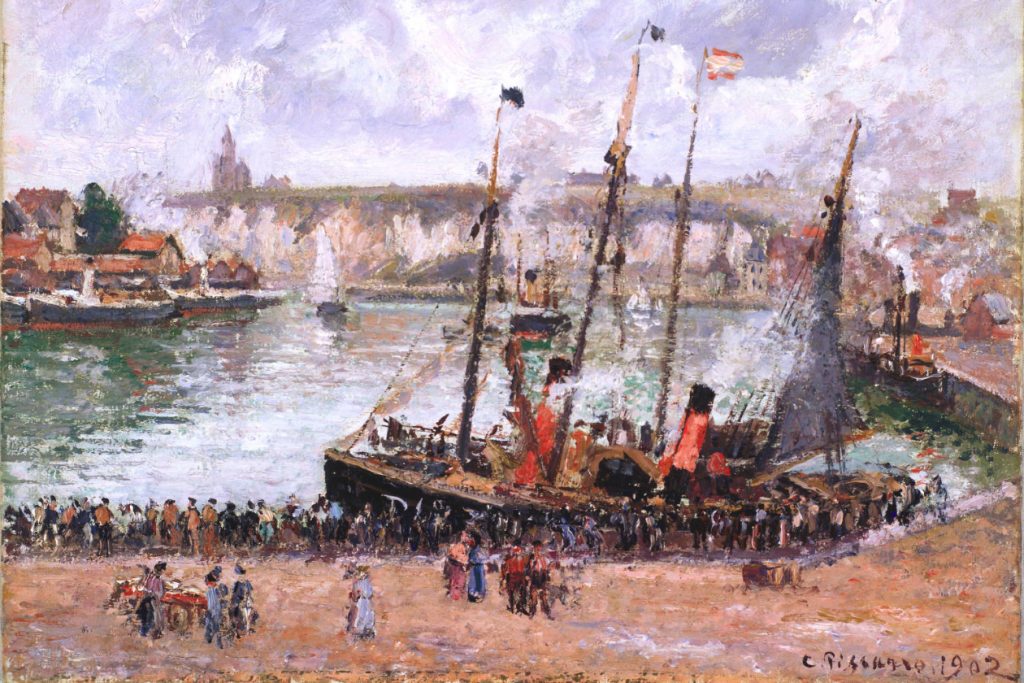
Then we entered a room of French impressionists, and I found myself standing before a painting by Pissarro, a view of a Normandy harbour. To this day I don’t know whether it was a particularly good painting, but suddenly it seized me and drew me in, and I found myself caught unawares in a completely different state of consciousness. What struck me most was the contrast between the ordinary, distracted mode of perception I had been in and the aesthetic mode that the painting had suddenly provoked. I am interested to understand that difference, and I want to begin by offering an analysis of the different modes of knowing.
Generally speaking, in the midst of our ordinary lives, we employ two modes of knowing. The first and most obvious is the mode of perceiving. We perceive a world full of objects among which we ourselves are situated. Our senses deliver us information, and we assemble from that a complex but coherent whole, which we apprehend from a single unity of perspective. Again, this is what Schopenhauer called the ‘original disposition of the mind’ — the innate structuring that enables an organism to know the world. It is the mode of knowing we inhabit almost all the time, and we take it to deliver reality itself. Quite unthinkingly we assume that we are perceiving the real world, occupied by a real person.
The second mode of knowing involves breaking the flow of perceptual experience into generalised concepts. We generalise ‘word’, we generalise ‘book’. In truth, every book is unique and cannot fully be captured by the blunt term ‘book’; yet the concept is immensely useful if I want someone to fetch a book from the shelf. In this way, we translate the minute particularities of our experience into portable concepts, which are abstractions drawn from perceptual experience. Conceptualising arises from perceptual knowing and, properly understood, returns to it. When I use the concept ‘book’, I do so to guide you toward the elements of your perceptual experience that matter. Knowing in the form of conceptualising is thus a kind of second-hand experience: an abstraction from perception into the medium of concepts, which we then use to locate ourselves in space and time, learn from the past, and plan for the future. The entire structure of human culture is mediated by this capacity to employ concepts.
These are the two primary modes of knowing. Much of the routine of our lives (and my goodness, isn’t most of life routine?) is conducted under these two headings. But from what I have said so far, we can already begin to recognise the limits of perceiving, and therefore of conceiving. Perceiving is limited because we do not perceive reality directly; we perceive images. These images are in some mysterious way related to what we cannot but think of as reality, but we don’t perceive whatever it is that the image is an image of — what Kant called the ‘thing in itself’. Even the notion that something ‘stands behind’ our experience is a spatial metaphor, a conceptualised image drawn from perception. Our perception is, in fact, what Schopenhauer called Vorstellung, or ‘representation’, and what Yogācāra calls vijñapti. This is not merely high philosophy; it is also common sense. Reflect on your own experience of perception, and it becomes clear that what you apprehend are not things themselves, but the images you help to create. Out of what? On what basis? — that is another question, which I will not pursue here. As for conception, insofar as it generalises from perceiving — which is itself mere representation — it must be what Schopenhauer called ‘representation of representation’.
All our experience ultimately is Imagination.
So much for those two forms of knowing. Useful though they are, they remain strictly limited when it comes to apprehending the fullness of reality. How, then, can we go further? There is, of course, an immediate difficulty: in trying to speak of any means of knowing that goes beyond, we are constrained to use concepts derived from within the field of representation. Moreover, we must recognise that we have different levels of language at our disposal. The first level consists of concepts that is used to describe immediate perceptual experience. The second level is the language of abstract conceptualisation, through which we step further from the immediacy of perception. There may be fine shades between these two, but there is a genuine difference. Here I am employing a mixture of the two languages. My account of the Singapore art gallery experience relied largely on perceptual description. Now, as I begin to draw out larger themes and understandings, I am engaging in a more abstract use of concepts. Yet both levels of language remain bounded by the limitations of perception, since they originate within that framework.
What lies beyond that, strictly speaking, cannot be spoken of. The wonder of the Buddha is that he managed to say so much while refusing to say what could not be said. That, in my view, marks the essential difference between Buddhism and other religions. Hinduism, for example, ventures into vast speculations about the ultimate nature of things and their relation to the intimate nature of things, and thereby presents huge hostages to misunderstanding. This is why one can practice caste while believing in an ultimate ātman. The moment you enter the speculative realm of trying to speak of what is unspeakable, you open the door to the many evils to which religion is so easily prone. The Buddha refused to do that, fully aware of the limitations of language.
However, refusing to say more than can strictly be said is itself not without its dangers. It leads to what Sangharakshita called the ‘charge of nihilism’, which has so often, and so mistakenly, been made against Buddhism. Unless we can find some way of thinking about what lies beyond the world of representation, we risk concluding that nothing does. We imagine ourselves confined to the world as it ordinarily appears, and when that appearance fades — when the eyes close for the last time — we suppose that the lights simply go out, and that is the end of it.
Fortunately, we have another kind of language — one that is alive even within the Buddha’s own discourse, though not made explicit. I mean the language of images. The language of images — in metaphor, symbol and myth — brings us closer to another mode of knowing, one that lies beyond perception and conception, and nearer to the truth of things. That other mode of knowing is, of course, Imagination. This is, I would argue, the real mode of knowing. Even our perceptual knowledge is a form of imagining. The objects of perception are not independent of us, and we ourselves are an image. All experience is, in the end, Imagination. Even our concepts are derived from representations that are themselves the work of the Imagination. Imagination is our real life; it is our true knowing; it is what consciousness most deeply is.
In the aesthetic moment we let go of the modes of knowing that are perceiving and conceiving. We let go of conceiving in so far as, at least to some extent, we stop thinking. The more your little brain is ticking out concepts, the less aesthetic your experience is. It may be that a certain amount of thinking generates in you a more immediate experience, but it does so by pointing you away from thinking and towards Imagination. This is the function of poetry, as well as really intelligent Dharma teaching.
When the Imagination begins to flower, image perceives image, or even better, image imagines image.
In the aesthetic moment we also leave behind perceiving, in the sense of interpreting experience under the headings of space, time, and causality. We loosen, too, the distinction between subject and object, insofar as both become image — or, in Sangharakshita’s words from ‘The Journey to Il Convento’, image perceiving image. When the Imagination begins to flower, image perceives image — or better still, image imagines image. There is only imagining.
Right now, that is what is happening: you are an image, and you are imagining images. These images arise in dependence upon causes and conditions, which are ultimately unfathomable because you can only trace them so far — and even that tracing is useful only within the world of perception and conception. When you let go of that world, you simply experience the creative fountain of images, unfolding like the petals of a flower.
In a wonderful seminar on The Tibetan Book of the Dead, Sangharakshita spoke of the mandala of the Five Buddhas, and of how in the bardo the Five-Buddha Mandala effloresces. First, each Buddha-figure emerges one after another, day by day; and then they begin to riot. Each Buddha explodes into multiple Buddhas and Bodhisattvas, which in turn burst into all sorts of weird and wonderful figures. Sangharakshita described this as an image of Enlightenment itself. Without such an image, one might think of Enlightenment merely as a coming to an end — and in a certain sense, it is: an end to clinging to representations as literally referring to ‘me’ and ‘things’, and to concepts as truly describing reality. But imaginatively speaking, it is not the end of anything; it is the beginning of everything. When we allow ourselves to experience imagination increasingly free from the bounds of perceptual and conceptual representation, we experience ourselves as image-imagining-image — and that as an inexhaustible spring of creative energy, if we want to call it anything at all.
That is what art connects us to — together with everything else we do in our spiritual lives. Art can lead us deep into the Imagination, and I believe the greatest artists touch such depths that they bring us to the very gateways of reality itself — to things as they really are. They show us Imagination as the life of everything, as the force that generates all our experience. Without art, and without the language of images, our Dharma practice easily becomes a matter of technique, and our realisations mere conceptualisations — clever, penetrating, perhaps even important, but lacking the power, depth, and ineffability of Imagination, which sweeps us into dimensions where we are simply image, and what we perceive or imagine is simply image. Indeed, I have come to think that the idea of ‘no self’ means not so much recognising that there is no image that is you, but recognising that you are an image. One could say that you are nothing more than an image, but that sounds as though being an image is not very much. On the contrary, to be an image, and for that image to be no different from the image that it knows, is to be Imagination itself. And that image-imagining-image is Reality itself.
Further than that I cannot go, and perhaps I have already given too many hostages to fortune. But I hope I have conveyed something of the depths to which even our own aesthetic moments can take us, and into which the greatest aesthetic guides humanity has produced can lead us deep, deep indeed. The greatest art touches those depths because the artists themselves have touched them, and possess the skill and craft to communicate their insight and understanding through the sensuous medium before them. Shakespeare, in creating Hamlet, did not merely create a wonderfully engaging drama; he touched the depths of humanity, of what it is to be alive, what it is to know. Many artists have glimpses and can communicate something of what they see, but the greatest take us right into the heart of reality, because they show us Imagination — not our imagination, nor even their imagination, but Imagination itself, beyond the boundaries of perception and conception, beyond space, time, and causality, beyond self and other. It is just Imagination, and we are image-imagining-image.